Note: Obs! Subject to change!
Prof. Gerald Maguire <maguire@kth.se>
is an examiner for thesis projects (primarily) on: data communication,
mobile communication, personal communication, ... . Note that he
spends a large fraction of his teaching time supervising
exjobbs. For examples of past thesis projects, see DiVA.
If you have been offered a thesis project (exjobb) in industry
which you think he might be the relevant academic advisor and examiner
for, then send the description of the proposed project to him via
e-mail -- before stating on the project. If you have an idea
of your own or are looking for an idea in an area which you think he
would be a suitable academic advisor and examiner, send him mail.
Students needing an "Intyg" for CSN should directly contact their study
adviser or the relevant administrative office (such as ICT's Student
Centrum (Studentcentrum)), as I cannot sign such documents.
Registration forms are available from your school/program.
There is some useful information in the following two presentations
the 23 of January 2009:
Ben Slimane's presentation on procedures for exjobbs and
G. Q. Maguire Jr,'s Scientific
method, Previous work, Literature study, Plagiarism, ...: Some useful tips for those doing a masters thesis project.
Please note that all correspondence with me regarding your thesis
project should be done via your KTH e-mail account.
In keeping with the KTH policy regarding putting the final thesis in DiVA -
I expect that all students that I am an examiner for will agree to put
the full text of their report on-line.
New exjobbs with grading
Since 1 July 2007, it is possible to have the following types of
exjobbs with a grade:
- Civilingenjöexamensarbete - 30 hp as part of the Civilingenjöexamen 300/270 hp program
- Magisterexamensarbete - 30 hp as part of the Magisterexamen 120 hp program
- Magisterexamensarbete - 15 hp as part of the Magisterexamen 60 hp program
For further information see the information about the specific
course..
My advice to all thesis project students is:
- Do not panic! There are lots of things that you will not know, but
you can learn them.
- Get in the habit of writing. Try to write at least one page per
day. If you think of a question write it down. When you think of an
answer write it down. Once a week step back and look at the table of
contents for your thesis as you plan the next week's activities.
- Write your draft titlepage and abstract - the first night of your
project. (This will help you keep your focus.)
- Look at your table of contents at least once every week - as you plan your next
week. Avoid getting stuck in a local minima.
Generic timeline and its relation to what you must write
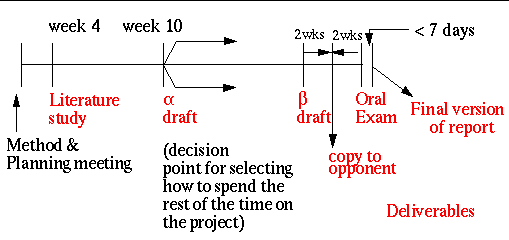 |
The literature study should consist of the following parts of the final
report (i.e., it is just an early version of the final report
containing only a limited subset of the report):
- Title page
- Title
- Author
- Date
- State where you are doing this work
- Abstract
- Short problem statement
- Why is this problem worth an masters thesis project?
(i.e., Why is the problem both significant and of suitable
degree of difficulty to be worth an masters?)
- How are you going to solve the problem?
- If all goes well, what do you think can be done after you
finish - that can not be done now?
- Introduction
- Longer problem statement
- General introduction to the area
- Background
- What have others already done?
- What does a reader (another x student -- where x is your study line) need to know to
understand your report?
- References
I encourage students to use Zotero for
their reference management. Of course you can also use a commercial
tool or other tool. The key is that you should be using a tool to
facilitate working with your references and reference material. (For a
comparisons of difference systems see http://en.wikipedia.org/wiki/Comparison_of_reference_management_software.)
You can find examples of using Zotero in my II2202 lecture notes on
powertools and
Writing and Oral Presentations.
I encourage you to use my Zotero style
ExampleStyle-with-access.csl as it provides a rather complete reference
(including DOI, ISBN, or URL where relevant). For those who want a
bibliographic style which is similar to IEEEtran, but with ISBNs,
DOIs, and URLs, see myIEEEtran.bst.
Note about language(s)
The thesis is generally written in Swedish or English. There must
be an abstract in both Swedish and English. Under certain
circumstances, and with the approval of the supervisor, the thesis may
be written in another language, but must still have abstracts in
both Swedish and English
(see "Language Policy for KTH 2010",
Dnr V-2009-0365, doss 1, section 4.10: "Abstracts of dissertations and
theses "Every Master's dissertation, licenciate thesis and doctoral thesis
that is written in English is to include a Swedish Abstract. Similarly,
every dissertation or thesis written in Swedish is to have an English
Abstract.").
A student may also have a version of the abstract in additional
languages. For example, students in double degree programs and
exchange programs may need to have a version of the abstract in the
language of their home instition.
Possible - Exjobb report outline
- Title page
- Title
- Author
- Date
- State where you are doing this work
- Abstract
- What is the topic area? (optional)
- Short problem statement
- Why was this problem worth an M.Sc. thesis project?
(i.e., why is the problem both significant and of suitable
degree of difficulty to be worth an M.Sc.? Why has no
one else solved it yet?)
- How did you solve the problem? What was your method/insight?
- Results/Conclusions/Consequences/Impact:
What are your key results/conclusions?
What will others do based upon your results?
What can be done now that you have
finished - that could not be done before your thesis project was completed?
- Acknowledgements
- Table of Contents
- Introduction
- Longer problem statement
- General introduction to the area
- Background
- What have others already done?
- What does a reader (another x student -- where x is your study line) need to know to
understand your report?
- Method
- What are your goals? (What should you be able to do as a
result of your solution - which couldn't be done well
before you started?)
- What you are going to do? Why?
- Analysis
- How you are going to evaluate what you have done?
- Analysis of your data and proposed solution
- Does this meet the goals which you had when you started?
- Conclusions
- Conclusion
- Did you meet your goals?
- What insights have you gained?
- What suggestions can you give to others working in
this area?
- If you had it to do again, what would you have
done differently?
- Future work
- What you have left undone?
- What are the next obvious things to be done?
- What hints can you give to the next person who is
going to followup upon your work?
- Required reflections (see the section about this
below,
specifically the "Values and attitudes" section)
- References
- Appendix/Appendices (Optional) - one of which might be a list of
abbreviations or terms which you use in your report.
Notes about writing
- For your document, you should be sure to use A4 sized paper rather than US letter.
- Set the text in a serif font, such as Times Roman (as it is much
easier to read a lot of text when there are serifs). Also it is nice
to indent the first line of each paragraph by 2-3 ems (this is the
width of the letter "m" in the current font size). Also fill and
justify the paragraphs of the body of the report.
- For those using LaTeX, you can improve the look of the document by:
- switching to using PostScipt fonts
(instructions)
- You can also turn off hyphenation or at least limit its use
with "\hyphenpenalty=5000 \tolerance=1000"
- Manually break lines with \linebreak[1] - this will allow
LaTeX to break the line while still justifying the text. The
numeric argument can be used to be more insistent about breaking the
line. Useful values are 1..4.
- BibTex entries for W3C publications
- BibTex entries for RFCs
- IEEE and ACM provide BibTeX entires for their publcations
via the web page for each publication
- Use the
bytefield package to draw packet structures
- Gilles Bertrand has some nice
LaTeX tutorials, for example how
to draw call flows using the xy package and
how to draw Markov chains.
- pcap2tex - see
http://www.wireshark.org/lists/wireshark-users/201007/msg00258.html
- Rather than using numeric superscripts it is better to use
symbols
- Another useful tool is Zotero
- there are plugins for OpenOffice and Microsoft's Word.
- Read your document before submitting it - if you have unresolved
links, missing references, etc. fix them before submitting a draft
Some common flaws in theses
- Incomplete references - see the references in the lecture notes
for my course for examples of references
- Missing important citations
- Statements made without justification or supporting citations
- Poor (or no) editing
- Failure to spell check the document
- Not checking grammar - see a tool such
as Grammarly to help you.
See also the Writefull
Overleaf Extension
- Documents where it is clear that no one looked at the document after formatting
- often these have breaks in the middle of sentences, missing phrases,
... .
- Lack of page numbers
- Unreadable text in figures
- Failure to label elements of figures adequately
- Use of contractions (Do not use contractions in a formal report.)
- Use of acronyms or abbreviations without properly introducing
them; often failure to use these acronyms and abbreviations
consistently through the rest of the paper
- Redundant text
- Using figures from others without the copyright owner's permission
- Using too few refences, so the paper looks like simply a cut and
paste edit of these references.
- Single sentence paragraphs
- Lack of vertical white space between paragraphs, which in some
cases makes it hard to understand where new paragraphs begin
- Lack of a date - every document should have a date, in addition to title and author(s)
- Lack of section, subsection, ... number - makes cross references difficult
Partial list of ways to fail a degree project
- Not writing in the thesis on a daily basis,
- Not having a clear research methodology and a clear timeline,
- Not in mind both the work within the company and the KTH requirements for the degree project,
- Not giving enough priority to the thesis project, and
- Trying to do too many things (i.e. loosing focus on the problem you are trying to solve).
Further notes about writing
For those writing in English an excellent resource is:
Chicago Editorial Staff, The Chicago Manual of Style. 14th edition,
923 p., 1993, ISBN 0-226-10389-7
The
Chicago Manual of Style (FAQs)
For a suggest of how to handle (format) on-line reference, see
Online sources
A generally useful book for writers is:
Marie-Claire van Leunen, A Handbook for Scholars, Oxford Univ. Press,
1992.
A useful guide for reports in Swedish:
Skrivregler för svenka och engelska från TNC, Terminologicentrum TNC, TNC 100, Solna, 2001. ISBN 91-7196-100-3.
See also KTH's language tools.
Note that under the Bern Convention every figure has its own
copyright, thus if you are going to use a figure from someone else you
must make sure that you have the copyright owner's
permission. Generally when you get this permission they will say how
they wish this to be acknowledged. This is in addition to your
existing obligation to properly cite your sources.
For an nice introduction to statistics for usability studies, see
chapter 2 of Tom Tullis and Bill Albert, Measuring the User
Expeience: Collecting, Analyzing, and Presenting Usability
Metrics, Morgan Kaufmann, 2008, ISBN 978-0-12-373558-4
Edoardo Paone's
presentations slides -- appear here with the permission of the author.
Vassilios Ververis's
presentations slides -- appears here with the permission of the author.
for some guidance about citing software see: Mike Jackson, "How to
cite and describe software", Software Sustainability Institute, Last updated: Tuesday 4 September 2012,
avialable from:
http://software.ac.uk/so-exactly-what-software-did-you-use
Note the very useful function in R to get the BibTeX for R or a
package:
    x=citation()   # to get the citation information for R
    toBibtex(x)
or
    x=citation('packagename')
    toBibtex(x)  # to get the BibTeX entry for the package whose name you have entered above
Thesis statistics
Some interesting statistics about past theses:
Length (over time), Histogram of
lengths, and CDF of lengths.
For some statistics on distribution of thesis presentations over the
years, the year, the months, days of the months, days of week, hour
of the day (when the oral examination started), and number of exams per day. From these we can see that June and December
are the major months for presentations; there is a possibly small
cluster of days at the end of the month - but just about any day of
the month exams have occured; and Monday, Thursday, and Friday are the
most popular days for presentations. One can also see that except for
the low at noon and the peak at 13:00, the starting times are rather
spread over the day. Additionally, it is quite rare to have 3 or 4
exams on the same day, but about 1/3 of the examinations took place on
the same day as another exam.
Abstracts
Length of abstracts in the period from 2010 to 2014.06.30
| All examiners | Maguire | |
|---|
| in English | in Swedish | in English | in Swedish | description |
|---|
| 241 | 207 | 289 | 207 | median |
| 62 | 61 | 100 | 98 | minimum (non-zero) |
| 644 | 572 | 606 | 509 | maximum |
Approximately 90% of all English language abstracts for theses examined by
prof. Maguire are between 200 and 450 words. Note that databases such
as ProQuest Dissertations & Theses (PQDT)limit abstracts to 350
words. While Canada's National Archive limits Masters thesis abstracts
to 150 words (and Doctoral dissertation to 350 words). Chalmers
University of Technology suggests a Master's thesis abtract should be
between
250 and 350 words.
At ICT, the median length of abstracts in number of paragraphs is 3
with a standard deviation of 1.9 paragraphs.
For a short description of how to write an abstract, see Philip Koopman,
How to Write an Abstract,
Essay, Carnegie Mellon University, October, 1997.
Keywords
Choosing good keywords can help others to locate your thesis and related theses.
When choosing keywords consider the following:
- Choose the most specific keyword from those used in your domain, see for example:
- If there is no existing keyword that is suitable, then considering introducing a
keyowrd of your choice - but remember that doing so may make it harder
for someone else to find your thesis. This will typically only be
necessary when a new keyword comes into use due to the evolution
of a field. [Note: Former IEEE Transactions on Antennas and
Propagation Editor-in-Chief, L. Wilson Pearson, added only
150 new
keywords in the 2-1/2 years he was editor]
- Think about what someone else would use as a keyword to find your
thesis along with related theses from among millions of theses.
- The first letter of a keyword should be set with a capital letter
and proper names should be capitalized as usual.
- Spell out acronyms and abbreviations.
- Avoid "stop words" - as they generally carry little or no information.
- List your keywords separated by commas (",").
- Since you should have both English and Swedish keywords - you
might think of ordering them in corresponding order (i.e., so that the
n-th word in each list correspond) - thus it would be easier to
mechanically find matching keywords. Personally, I think
this paired ordering would be better than alphabetizing each list independently.
A list of paired English-Swedish kewords used in theses at KTH as
of 2014.08.11 can be found here
and the list of keywords by
school extracted from theses. Both of these sets of keywords have
been edited by hand to deal with problems in the actual set of
keywords stored in DiVA. For non-empty sets of keywords, the median
number of keywords is 5, with a minimum of 1, a maximum of 43
(English) 146 (Swedish), and a minimum and maximum standard deviation
ranging from 3 to 5. For this one can draw the conclusion that a
typical thesis should have 5-6 keywords (typical of the limited number
of keywards (4-10) many publications enforce).
Each student is advised to write a section in their thesis to
ensure that they address the issues described in Higher Education
Ordinance (1993:100) concerning Values and attitudes. The
thesis as a whole should also meet the requirements stated in the
sections Knowledge and understanding and Skills and
abilities (as relevant to their specific degree - see the formal
Swedish rules at the end of this page).
From
Högskoleförordning (1993:100)
"Värderingsförmåga och förhållningssätt

  För civilingenjörsexamen skall studenten

  - visa förmåga att göra bedömningar med hänsyn till relevanta
  vetenskapliga, samhälleliga och etiska aspekter samt visa
  medvetenhet om etiska aspekter på forsknings- och
  utvecklingsarbete,

  - visa insikt i teknikens möjligheter och begränsningar, dess
  roll i samhället och människors ansvar för hur den används,
  inbegripet sociala och ekonomiska aspekter samt miljö- och
  arbetsmiljöaspekter, och

  - visa förmåga att identifiera sitt behov av ytterligare
  kunskap och att fortlöpande utveckla sin kompetens."


"Värderingsförmåga och förhållningssätt

  För masterexamen skall studenten

  - visa förmåga att inom huvudområdet för utbildningen göra
  bedömningar med hänsyn till relevanta vetenskapliga,
  samhälleliga och etiska aspekter samt visa medvetenhet om
  etiska aspekter på forsknings- och utvecklingsarbete,

  - visa insikt om vetenskapens möjligheter och begränsningar,
  dess roll i samhället och människors ansvar för hur den
  används, och

  - visa förmåga att identifiera sitt behov av ytterligare
  kunskap och att ta ansvar för sin kunskapsutveckling."
The
Higher Education Ordinance (1993:100) (in English) specifies the
requirements for the degrees in Sweden. Of particular relevance to
thesis project students is the following (translated from Swedish):
Master of Science
Scope
The Master of Science degree is awarded only after the student has
completed a specific program's course requirements for 300 credits.
Target
MSc students must demonstrate the knowledge and skills required to work independently as a civil engineer.
Knowledge and understanding
MSc students must:
- Demonstrate knowledge of the chosen technology, the scientific basis
and proven experience and insight into current research and development,
and
- Demonstrate both broad knowledge in the chosen field of engineering,
including knowledge of mathematics and science, and substantially deeper
knowledge of certain parts of the area.
Skills and abilities
MSc students must:
- Demonstrate an ability to holistic, critically, independently, and
creatively identify, formulate and manage complex issues and to
participate in research and development and thereby contribute to the
development of knowledge;
- Demonstrate an ability to create, analyze, and critically evaluate different technical solutions,
- Demonstrate an ability to plan and use appropriate methods to carry out advanced tasks within specified limits,
- Demonstrate an ability to critically and systematically integrate
knowledge and demonstrate the ability to model, simulate, predict, and
evaluate the events even with limited information,
- Demonstrate an ability to develop and design products, processes and
systems with a view to human conditions and needs and society's objectives for
economically, socially, and ecologically sustainable development,
- Demonstrate the capacity for teamwork and collaboration in groups of different composition, and
- Demonstrate an ability to both national and international, orally and
in writing in dialogue with different groups clearly present and discuss
their conclusions and the knowledge and arguments that form the basis
for these.
Values and attitudes
MSc students must:
- Demonstrate an ability to make judgments with regard to relevant
scientific, social and ethical aspects, and demonstrate an awareness of
ethical aspects of research and development activities;
- Demonstrate insight into the possibilities and limitations, its role
in society and the responsibility for its use, including social and
economic aspects, environmental and social aspects, and
- Demonstrate an ability to identify the need for further knowledge
and to continuously upgrade their skills.
Independent work (thesis)
For the MSc degree, the student as part of their course of studies
must complete an independent project (degree project) worth at
least 30 credits.
For some examples of the "Required Reflections" section see the following theses:
Typically each oral presentation (by one or two students) is a
total of 25 to 35 minutes long. This is followed by questions and
comments from the opponent(s). Next the audience has a chance to ask
questions about the thesis. Finally, the examiner will ask any final
questions that they have. A typical oral presentation and examination
lasts a total of <1 hour.
A typical oral presentation addresses the following:
- Title slide: Project title[:subtitle], Name of student(s) who
conducted the project, Date of the oral presentation, Where the
project was conducted, Name(s) of supervisor(s) and examiner(s).(1 slide)
- Problem statement, Why the problem is important to solve, and your
Goals, problem context, delimitations, ... (1 or 2 slides)
- Background and Related work (b slides)
- Method used to solve the problem (m slides)
- Results and Analysis (r slides)
- Conclusion (1 or 2 slides)
- Future work (1 or 2 slides)
- Final slide - to solicit questions (1 slides)
The typical number of slides will be less than ~30, hence b+m+r <
25 slides. However, it is advisable to have backup slides (after your
"Final" slide) to show any figure/table/formula/... that your
audience is likely to ask about. Alternatively, you can have a
version of your thesis draft ready in a suitable viewer - so that you
can show any part of it that might be necessary to address any
questions that come up.
Keep in mind that only the opponent(s), supervisor(s), and
examiner(s) are likely to have read the who thesis beforehand - so you
need to present the key points of your thesis project in your oral
presentation at a level that the audience will be able to understand:
what was the problem, why was it important to solve, what others have
done, what you did, what you learned, and what should be done next.
Note that students are not allowed to use the KTH logo on their slides.
You should have a slide number on each of your slides (other than
the title slide) to help listeners take notes - so that they can
reference their questions to specific slides.
Avoid complex slide backgrounds and make sure that what you want
your audience to be able to see will be visible (this means avoiding
small fonts, yellow text/lines, ... ).
Self-evaluation with respect to The Higher Education Ordinance (1993:100) goals
If you want to do a self-evalutation of how well your thesis fulfills
the requirements for your educational requirements see the
spreadsheet.
Your primary goal as an opponent is to help the student improve
their thesis. A secondary goal is to help the student improve their
future oral presentations. Achieving both of these goals is based upon
providing feedback. There is a template for the opponent's report that
you should complete. Generally you should begin your oral opposition
with what you liked about the oral presentation, then comment on what
could be improved. Following this you should ask the questions that
are still unclear after having read the thesis and after having heard
the student's oral presentation. You should also have ~10 minutes of
questions for the student after their presentation in order to start
off the question and answer period. You can find a template and
examples of opponents reports below.
Exjobb opposition report

Reviewer name:
Date of review:

Title:

Author:

Section I. Evaluation
Category:
Relevance of content:            1 to 5 (5 excellent)
Disposition:                     1 to 5 (5 excellent)
Evaluation of published results: 1 to 5 (5 excellent)
Abstract:                        1 to 5 (5 excellent)
Conclusion:                      1 to 5 (5 excellent)
Presentation of related work:    1 to 5 (5 excellent)
Language:                        1 to 5 (5 excellent)

Section II. Recommendations

Section III. Detailed comments for the author
Examples of exjobb opposition reports (each appears here with the permisison of
its author):.
A form for GQMJr as examiner or
another examiner to sign when you have completed your
opposition - generally this should not be needed, but sometimes it is
useful to have something physical.
KTH common goals for a 30 hp Civilingenjöexamensarbete as part of the Civilingenjöexamen (300/270) hp program
"Studenten ska:
- Kunna tillämpa relevanta kunskaper och färdigheter som förvärvats inom
teknikområdet på ett givet problem
- Inom givna ramar, även med begränsad information, självständigt kunna
analysera och diskutera komplexa frågeställningar, samt hantera större
problem på avancerad nivå inom teknikområdet
- Reflektera kring, värdera och kritiskt granska egna och andras
vetenskapliga resultat
- Kunna dokumentera och presentera sitt arbete, för given målgrupp, med
högt ställda krav på struktur, formalia och språkhantering
- Kunna identifiera sitt behov av ytterligare kunskap och fortlöpande
utveckla sin kompetens
Dessa KTH-gemensamma mål ska utgöra grunden för kursmål för alla examensarbeten för
civilingenjörsexamen. Ytterligare eller mer specificerade kursmål för examensarbete kan utarbetas av
skolorna, för utbildningsprogram eller för enskilda examensarbetsämnen.
"
KTH common goals for a 30 hp Magisterexamensarbete as part of the Magisterexamen (120 hp) program
"Studenten ska:
- Kunna tillämpa relevanta kunskaper och färdigheter som förvärvats inom
huvudområdet på ett givet problem
- Inom givna ramar, självständigt kunna analysera och diskutera
frågeställningar och lösa större problem på grundnivå inom huvudområdet
- Reflektera kring, värdera och kritiskt granska egna och andras
vetenskapliga resultat
- Kunna dokumentera och presentera sitt arbete med krav på struktur,
formalia och språkhantering
- Kunna identifiera sitt behov av ytterligare kunskap och ta ansvar för sin
kunskapsutveckling
"
KTH common goals for a 15hp Magisterexamensarbete as part of the Magisterexamen (60 hp) program
"Studenten ska:
- Kunna tillämpa relevanta kunskaper och färdigheter som förvärvats inom
teknikområdet på ett givet problem
- Inom givna ramar, självständigt kunna analysera och diskutera
frågeställningar, samt hantera större problem på grundnivå inom
teknikområdet
- Reflektera kring, värdera och kritiskt granska egna och andras resultat
- Kunna dokumentera och presentera sitt arbete, för given målgrupp, med
krav på struktur, formalia och språkhantering
- Kunna identifiera sitt behov av ytterligare kunskap och fortlöpande
utveckla sin kompetens
"
For information contact maguire@kth.se
Last update:
21 June 2022


